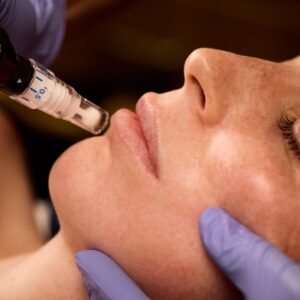
UltraMD laser treatment — the comb tip parts hair to deliver energy precisely to the scalp surface.
Quick Summary — What You'll Learn
Why topical treatments alone rarely work long-term
What the UltraMD 1927nm laser actually does to the scalp
The difference between KeraLase, PRF, and PDGF+ serums
What results look like and how many sessions you'll need
Who is a good candidate (and who isn't)
This month's special — and why it's a great time to start
Let's talk about hair thinning — honestly.
Hair thinning is one of those things people don't always talk about openly, but I see it in my practice constantly. It affects women and men, it starts earlier than most expect, and it carries a real emotional weight that I take seriously. I don't approach it as a vanity concern. For many of my patients, their hair is tied to their identity, their confidence, and how they show up in the world.
The good news is that we are living in a genuinely exciting era for hair restoration. Non-surgical, no-downtime options now exist that can make a meaningful difference — if they're delivered correctly. That last part is where most people get disappointed: they try an over-the-counter serum or a supplement and see nothing. It's not that the active ingredients don't work. It's that they can't get where they need to go.
That's exactly the problem the UltraMD laser solves.
Surgical procedures, injections, or needles needed
Why your scalp is the problem — and the solution
Here's something most people don't realize: your scalp's outer layer — the stratum corneum — is an extremely effective barrier. That's its job. It protects you from the outside world. But it also blocks the vast majority of what you apply topically from penetrating to the depth where hair follicles actually live.
Your follicles sit 3–5mm below the scalp surface. A topical serum, no matter how high-quality, absorbs only a fraction of that distance under normal conditions. This is why over-the-counter products often underwhelm — not because the ingredients are ineffective, but because they can't reach the follicle environment where the real work needs to happen.
"The laser doesn't just treat the scalp — it opens it. In the minutes after treatment, we have a window to deliver growth factors at a depth that topical application simply cannot achieve on its own."
— Natasha Sherrill, FNP · New Age Medspa
How UltraMD laser hair restoration works — step by step
At New Age Medspa, we use the UltraMD laser system — a 1927nm Thulium laser with a specialized comb tip designed specifically for scalp treatment. Here's what happens during a session:
01
Scalp preparation
We assess your scalp, part your hair, and prepare the treatment area. The comb tip design allows us to deliver laser energy directly to the scalp surface, even through existing hair — so you don't need to shave or cut anything.
02
Laser microchannel creation
The UltraMD 1927nm Thulium laser creates thousands of microscopic channels in the scalp's outer layer. These channels are precise and controlled — they disrupt the barrier without damaging the follicles themselves. This is the key step that makes everything else possible.
03
Regenerative serum delivery
Immediately after the laser pass — while those microchannels are open — we apply your chosen regenerative serum (KeraLase, PRF, or PDGF+). The serum penetrates directly into the follicle zone at a depth that topical application alone cannot achieve. This is the window that makes the treatment work.
04
Low-level laser stimulation
Beyond just creating channels, the laser energy itself improves scalp circulation and stimulates follicular activity — extending the anagen (active growth) phase of the hair cycle and shifting dormant follicles toward active growth.
05
No downtime — back to your day
Sessions take approximately 30 minutes. There's no downtime, no scabbing, no need to avoid the sun for days. Some clients notice mild redness for a few hours. Most return to work immediately.
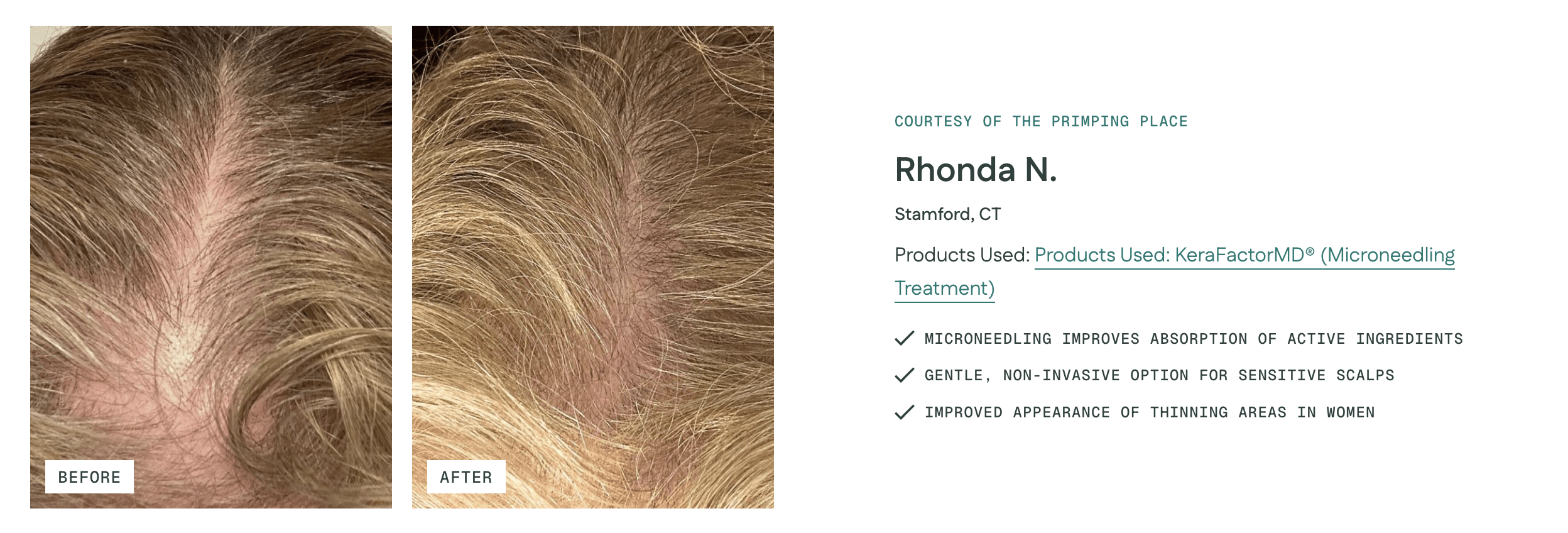
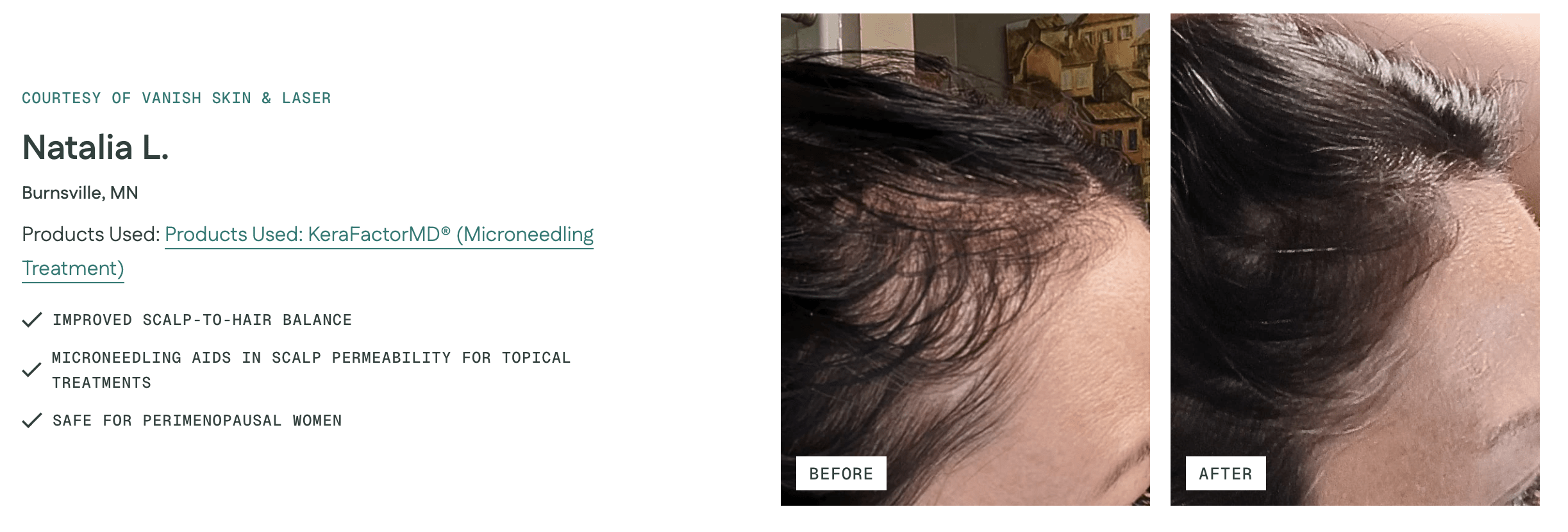
Before and after UltraMD + KeraLase treatment — increased density and scalp coverage in a female patient.
Which serum is right for you? KeraLase vs. PRF vs. PDGF+
The UltraMD laser is our delivery system — the same technology for every protocol. What changes is the regenerative serum we deliver through the open microchannels. At New Age Medspa, we offer three options, and which one I recommend depends on your hair loss pattern, goals, biology, and how your body responds.
Serum
What it is
Best for
Blood draw?
KeraLase
Cynosure's proprietary peptide & growth factor blend, formulated specifically for the UltraMD system
General thinning, scalp health, diffuse hair loss, first-time patients
None required
PRF (Platelet-Rich Fibrin)
Your own concentrated platelets and fibrin — drawn from a small blood sample and processed on-site
More significant hair loss, patients who prefer fully biological treatment
Yes — small sample
PDGF+ (Ariessence)
Pharmaceutical-grade platelet-derived growth factors in a purified, highly concentrated formula
Patients wanting maximum growth factor potency without a blood draw
None required
For most new patients, UltraMD + KeraLase is where we start — it's the most accessible entry point, requires no blood draw, and is very well tolerated. This is also what's on special this month with a complimentary Kérastase shampoo and conditioner included.
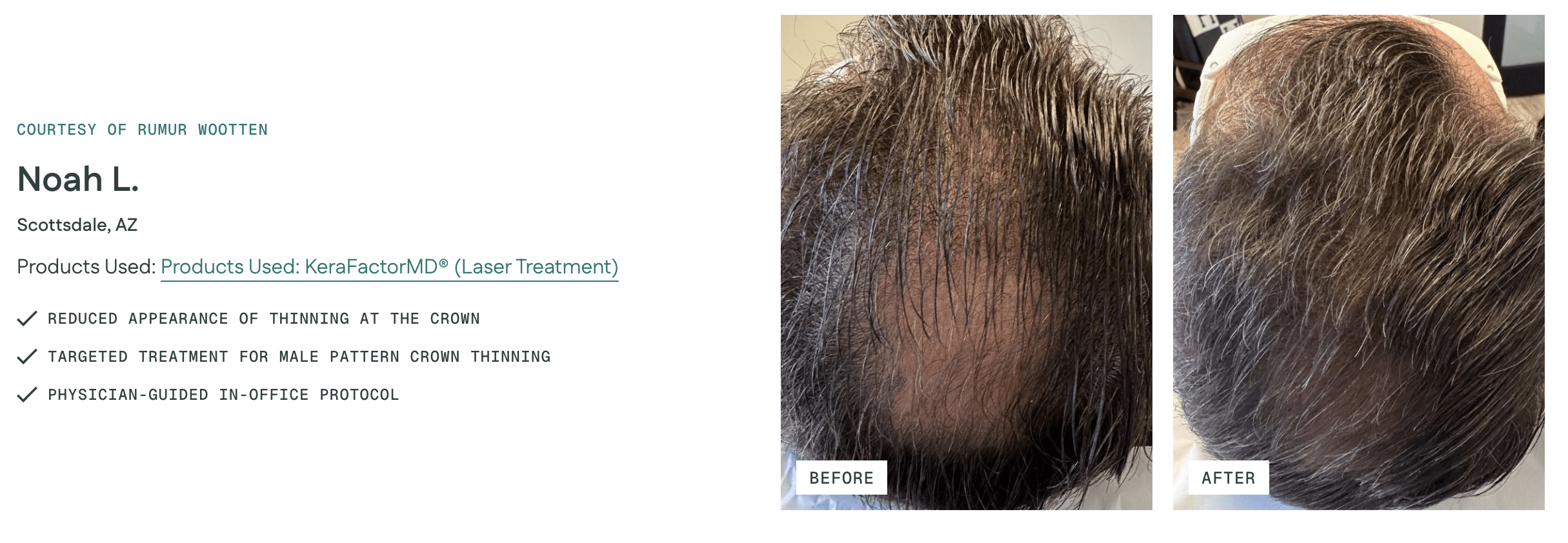
Real patient results — before and after a series of UltraMD + KeraLase sessions.
Who is a good candidate for laser hair restoration?
This treatment works well for a wide range of hair loss presentations. In my practice, I see it help:
Women with diffuse thinning or postpartum hair loss
Hormonal shifts, postpartum telogen effluvium, and age-related thinning all respond well. This is one of the most common presentations I treat.
Men and women with androgenetic alopecia (pattern hair loss)
The most common form of hair loss in both sexes. Earlier intervention produces better results — follicles that have been dormant too long cannot be reactivated.
Patients with overall scalp thinning or reduced density
If your hair feels less full everywhere — not just at the crown or temples — this treatment improves the overall follicular environment across the scalp.
Anyone who's tried topicals without satisfying results
If you've used minoxidil, biotin supplements, or other serums with limited success, the issue is likely delivery — not the ingredients. The laser changes that equation.
I generally don't recommend this treatment for patients with active scalp infections or inflammatory conditions, those who are pregnant, or those with very advanced hair loss where follicles are no longer viable. A consultation lets me assess your specific situation and be honest about what to expect.
April 2026 · Limited Time
UltraMD + KeraLase — This Month, With a Gift
Book your UltraMD + KeraLase hair restoration session in April and receive a complimentary Kérastase shampoo & conditioner set — formulated to extend your results at home.
I always want to be honest about timelines, because managing expectations is part of great care. Hair restoration is not an overnight process — and anyone who tells you otherwise isn't being straight with you.
Here's a realistic timeline for most patients:
1–3
Sessions: Reduced shedding
Most patients notice less hair in the shower drain and on their brush. Hair that is already growing often appears stronger and healthier. This is the first encouraging sign.
4–6
Sessions: New growth visible
Fine new hairs begin to emerge along the hairline and at the part line. Density starts to visibly improve. This is typically when patients feel real momentum — and when photos start looking noticeably different.
6–12
Sessions: Full results developing
Significant improvement in overall density and coverage. Most patients complete an initial series of 6–12 sessions, then transition to periodic maintenance to sustain results long-term.
Frequently asked questions
The UltraMD laser treatment is very well tolerated. Most patients describe a mild warming or tingling sensation on the scalp during treatment — not painful. There are no needles involved in the KeraLase protocol. Sessions are typically 30 minutes, and you can drive yourself home and return to work immediately after.
KeraLase is the name of Cynosure's proprietary regenerative serum — one of the options we deliver using the UltraMD laser system. At New Age Medspa, the laser (UltraMD) is the constant; KeraLase is one of three serums we can use depending on your goals and biology. We also offer PRF (using your own blood platelets) and PDGF+ (pharmaceutical-grade growth factors). The serum alone without the laser is far less effective — the laser-created microchannels are what make deep delivery possible.
Traditional PRP (Platelet-Rich Plasma) for hair restoration involves injecting your own concentrated platelets directly into the scalp with a needle — which can be uncomfortable and requires downtime. Our UltraMD protocol delivers similar or superior growth factors through laser-created microchannels rather than injections. For patients who want to use their own biological material, we offer PRF (Platelet-Rich Fibrin) — a more advanced form of PRP — delivered through the laser rather than injected. No needles required.
Pricing varies depending on the protocol you choose (KeraLase, PRF, or PDGF+) and the number of sessions. We discuss full pricing during your consultation. This month, our UltraMD + KeraLase sessions include a complimentary Kérastase shampoo and conditioner set. Financing is also available through Cherry if you'd like to spread the cost of a full series. I'd rather you start treatment than not start because of cost — reach out and we'll find an approach that works for you.
Yes — in many cases, laser hair restoration works well alongside other approaches such as topical minoxidil or prescription treatments. The laser actually enhances absorption of topicals applied at home after treatment, which is part of why we include the Kérastase shampoo and conditioner in this month's special. We'll discuss what a comprehensive protocol looks like for your specific situation during your consultation.
Absolutely — and honestly, the majority of patients I treat for hair thinning are women. Whether it's postpartum shedding, hormonal changes around perimenopause, or chronic diffuse thinning, UltraMD laser restoration is safe, non-hormonal, and appropriate across skin and hair types. It works on all hair lengths and densities — you don't need to cut or shave anything. Women's health is central to my practice, and I take hair thinning in women as seriously as any other health concern.
A word from me, as your provider
I know how personal hair thinning feels. I've sat across from patients who are embarrassed to even bring it up — who've been trying products for years and quietly losing hope. That's why I want to be clear: this isn't a gimmick, and it isn't a last resort. UltraMD laser restoration is a clinically grounded treatment that we use every week at New Age Medspa with real, visible results.
The key is starting before too much time passes. Follicles that have been dormant for years are harder to reactivate than those that are just beginning to thin. If you've been thinking about this, now is genuinely a good time — and this month's special makes it an even easier decision.
Come in for a consultation. I'll assess your scalp honestly, show you what I actually see, and tell you whether you're a good candidate and what realistic results look like for your specific situation. No pressure. No scripts. Just a real conversation about your hair.
New Age Medspa · Anchorage, Alaska
Ready to talk about your hair?
Book a consultation with our team — or explore our full UltraMD hair restoration treatment page to learn more before you come in.
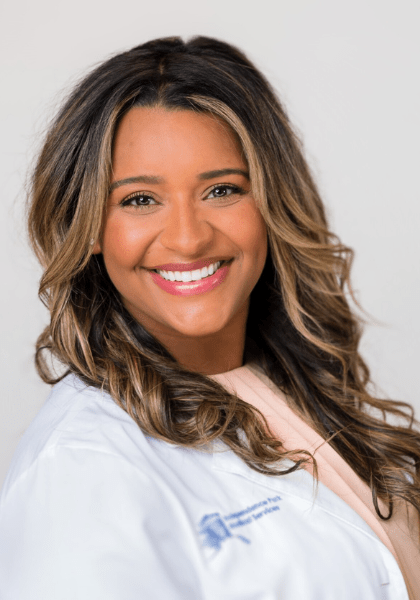
Owner & Aesthetic Injector · New Age Medspa Anchorage
Natasha is a Family Nurse Practitioner and the founder of New Age Medspa in Anchorage, Alaska,
with a background in trauma and cardiac intensive care. She specializes in natural-looking
aesthetic treatments, women's health, and non-surgical approaches to aging and hair restoration.
Read Natasha's full bio →