
Laser Resurfacing vs. Chemical Peels: Which Is Better for Acne Scars?
The honest answer is that it depends entirely on what kind of scarring you have — and most people have been told to treat the wrong one.

 Every acne scar plan at New Age Medspa starts with identifying which kind of scarring you actually have — before choosing a device or a peel.
- Flat, discolored marks are not scars. Red or brown spots left after a breakout are pigment, and chemical peels handle those well at a lower cost.
- Indented scars are a collagen problem. Boxcar, rolling, and ice pick scars need treatment that reaches the dermis — laser resurfacing or RF microneedling, not exfoliation.
- Rough texture and enlarged pores respond well to LaseMD Ultra, often in a series of three to five.
- Deep rolling scars usually need RF microneedling, which delivers energy below the surface where the tethering actually is.
- Most real plans combine both. Peels for tone, energy-based resurfacing for texture — sequenced, not stacked in one visit.
- In Alaska, start in the fall. September through April is the right window for resurfacing.
This is one of the questions Amy and I get asked most, and it's usually framed as a versus — laser or peel, pick one. I understand why. Both are marketed as the answer to acne scarring, both promise smoother skin, and the price difference between them is significant enough that it feels like a decision you have to get right the first time.
But the versus framing is what leads people to spend a year and several thousand dollars on the wrong treatment. Before you can choose between them, you have to know what you're treating. Acne leaves behind two completely different problems, and they respond to completely different things.
Let's sort that out first, then compare.
Are those scars, or are they marks?
Here's a test you can do at home tonight. Stand at a mirror and turn so a lamp hits your face from the side rather than straight on. Then look again.
If the mark only shows as color — red, purple, brown — and vanishes when the light is flat, that's post-inflammatory hyperpigmentation or erythema. Your skin's texture is intact. What's left is a pigment and vascular response to inflammation. It is not a scar, and it will often fade on its own over six to twelve months, though that's slow enough that most people want help.
If you see a shadow, a dip, or a divot that becomes more visible in side lighting, that's an atrophic scar. Collagen was destroyed during the inflammatory phase and never fully rebuilt. Surface treatments cannot fix a structural loss. That distinction is the whole article.
Most people have some of both. That's normal, and it's why the plan usually isn't one treatment.
The four things acne leaves behind
Each one has a different best answer. This is the framework Amy uses at consultation.
Discoloration (PIH and PIE)
Flat brown spots (hyperpigmentation) or flat red-to-purple spots (erythema). Common after inflammatory acne, and more persistent in medium and deeper skin tones. Texture is normal — this is purely a color issue.
Rough texture and enlarged pores
Skin that photographs fine but doesn't feel smooth. Often accompanied by visible pores across the cheeks and a general dullness. This is superficial-to-mid dermal — real, but not deep.
Boxcar and rolling scars
Boxcar scars have sharp, defined edges and a flat floor — they look punched out. Rolling scars are broad, shallow, wave-like depressions caused by fibrous bands tethering the skin down from underneath. Rolling scars in particular are a below-the-surface problem.
Ice pick scars
Narrow, deep, near-vertical channels — like the skin was pierced with a pin. They're the most difficult acne scar to improve, and I want to be upfront about that. Their depth-to-width ratio means resurfacing the surface barely touches the base.
 Chemical peels are strongest on pigment and tone — and they work best paired with a medical-grade home regimen rather than on their own.
What chemical peels actually do
A chemical peel applies an acid solution — glycolic, salicylic, lactic, TCA, or a blended formulation — that dissolves the bonds between dead surface cells and triggers controlled exfoliation. As the damaged layer sheds, newer, more evenly pigmented skin comes forward, and the process stimulates some collagen production underneath.
Depth is everything. A superficial peel works within the epidermis, gives you two to five days of light flaking, and can be repeated every four to six weeks. A medium-depth peel reaches the upper dermis, produces five to seven days of visible peeling, and does more — but carries more risk of pigment complications, particularly in deeper skin tones.
Where peels genuinely excel: post-inflammatory hyperpigmentation, overall dullness, uneven tone, mild surface roughness, congestion and active comedonal acne. They're also the most accessible entry point financially, which matters. A series of peels is a real treatment, not a consolation prize.
Where peels fall short: anything structural. A peel removes tissue from the top. An indented scar is a deficit of tissue underneath. Peeling the surface around a depression can very slightly soften its edges, but it does not raise the floor. If someone tells you a peel series will resolve boxcar scarring, be skeptical.
Amy runs our peel programming, including medical facials and ZO® Skin Health regimens. She's built peel protocols for a decade, and she'll be the first to tell you when a peel isn't the right tool.
 LaseMD Ultra creates thousands of microscopic treatment channels, leaving healthy tissue between them — which is why recovery is measured in days, not weeks.
What laser resurfacing actually does
Laser resurfacing uses light energy at a specific wavelength to create controlled thermal injury in the skin, which triggers a wound-healing cascade — new collagen, new elastin, reorganized tissue. Unlike a peel, it works by depth of energy delivery rather than depth of chemical penetration, which means it can reach the dermis without stripping the entire surface.
LaseMD Ultra, which is what we use, is a non-ablative fractional thulium laser. Fractional means it treats microscopic columns of tissue while leaving healthy skin between them intact — that untreated skin is what drives fast recovery. Non-ablative means it heats the tissue rather than vaporizing the surface, so you get resurfacing benefit without the two-week recovery of an ablative CO2 treatment.
Practically, that means redness and a sandpaper-like texture for about three to five days, some flaking around day three, and normal activity throughout. It's a series treatment — typically three to five sessions four weeks apart — and the results build across the series rather than arriving all at once.
Where laser genuinely excels: overall texture, enlarged pores, tone, stubborn pigment, fine lines, and the general quality and thickness of the skin. It also improves shallow atrophic scarring meaningfully. And there's a real bonus — the microchannels it creates allow far better absorption of the serums applied immediately afterward.
Where laser falls short: deep rolling scars with heavy tethering, and ice pick scars. Energy delivered from above can only do so much about fibrous bands pulling from below. That's where RF microneedling comes in.
Peels cost less per session and laser costs less per unit of improvement, particularly for texture. Comparing single-session prices is the wrong comparison. Compare the full series against the result you're actually trying to get. Our pricing page lists both, and payment plans are available.
For deep scars, the answer is often neither
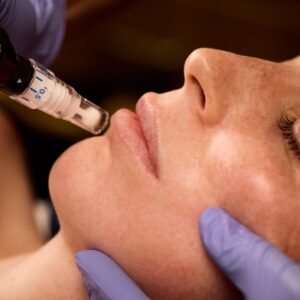
If your scarring is rolling or boxcar and reasonably deep, the most effective treatment we offer isn't a laser or a peel. It's RF microneedling — insulated needles that place radiofrequency energy at a set depth in the dermis, precisely where the collagen deficit and the tethering bands are.
It's uncomfortable in a way peels aren't, we numb thoroughly for it, and you'll have redness and some swelling for two to four days. But for indented scarring it consistently outperforms both of the treatments this article is nominally comparing, and it's safer across a wider range of skin tones than aggressive laser resurfacing.
For milder texture and for people who want to start gently, traditional microneedling with SkinPen is a reasonable and more affordable entry point — and it pairs well with a peel series.
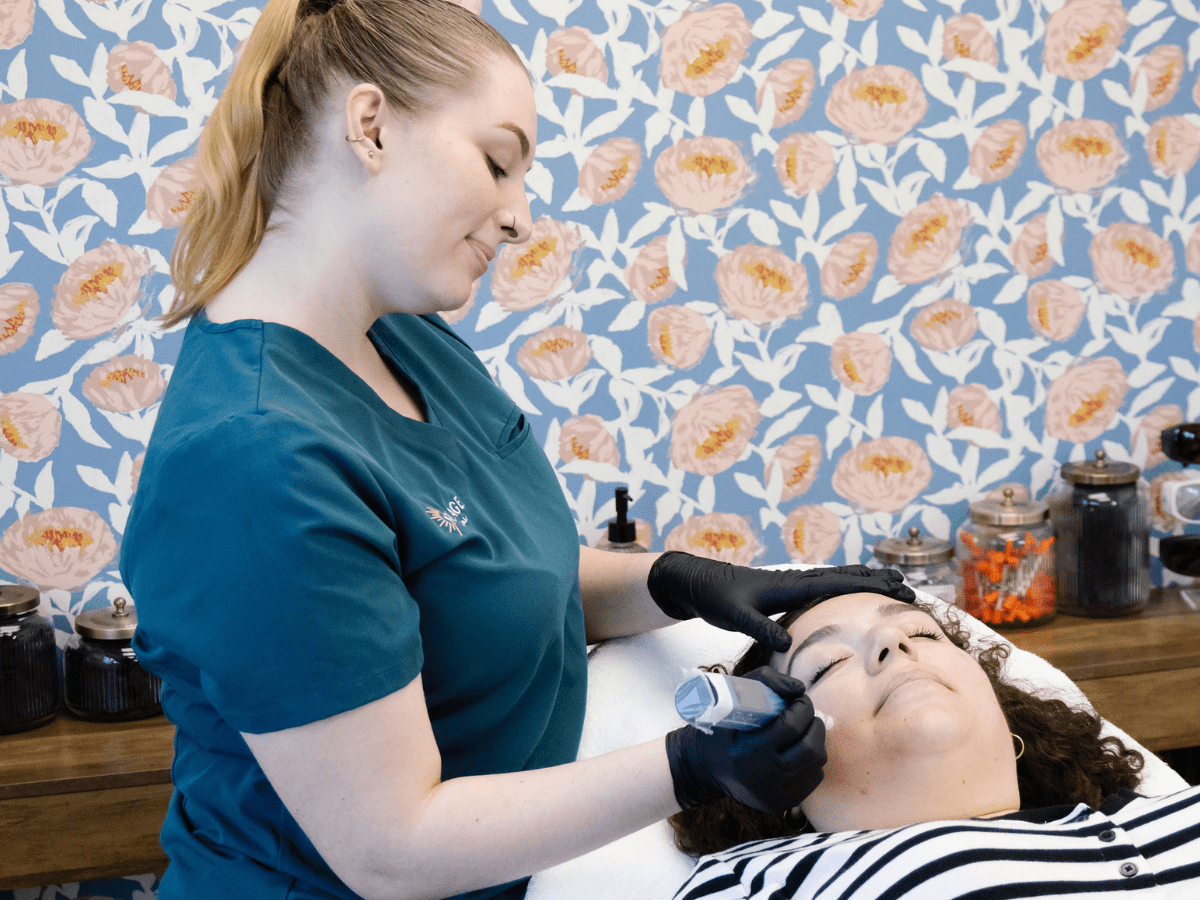 Microneedling with SkinPen is often the gentlest entry point into collagen-building treatment, and it layers well with a peel series.
Comparing the three real options
These aren't competitors. They're different tools for different depths.
Chemical Peels
Epidermis to upper dermis- Best for pigment, tone, and dullness
- Also treats active congestion and acne
- 2–7 days of flaking depending on depth
- Series of 3–6, every 4–6 weeks
- Lowest cost per session
LaseMD Ultra
Non-ablative fractional laser- Best for texture, pores, tone, and pigment
- Improves shallow atrophic scarring
- 3–5 days of redness and roughness
- Series of 3–5, every 4 weeks
- Enhances serum absorption dramatically
RF Microneedling
Dermal radiofrequency- Best for boxcar and rolling scars
- Reaches the depth peels and lasers can't
- 2–4 days of redness and swelling
- Series of 3–4, every 4–6 weeks
- Safer across a wider range of skin tones
| Concern | Chemical peel | LaseMD Ultra | RF microneedling |
|---|---|---|---|
| Brown discoloration (PIH) | Excellent | Excellent | Limited |
| Red marks (PIE) | Moderate | Good | Limited |
| Rough texture | Moderate | Excellent | Good |
| Enlarged pores | Moderate | Excellent | Good |
| Shallow atrophic scars | Limited | Good | Excellent |
| Deep rolling / boxcar | Minimal | Moderate | Excellent |
| Ice pick scars | Minimal | Minimal | Moderate |
| Active acne | Good | Not first-line | Not first-line |
| Typical downtime | 2–7 days | 3–5 days | 2–4 days |
"The question isn't laser or peel. It's how deep is the problem, and what tool actually reaches that depth. Everything else is marketing."
Natasha Sherrill, FNP-C · Founder, New Age MedspaHow we sequence it
Almost every acne scar plan we build uses more than one modality, spaced out over six to twelve months. Here's how it generally goes.
First, control the acne. Resurfacing over active inflammatory breakouts risks creating new pigment while you're trying to remove old pigment. If you're still breaking out regularly, we address that before starting a scar series. Certain peels help here, so this stage isn't wasted time.
Second, prep the skin. Four to six weeks on a medical-grade regimen — typically a retinoid, a pigment inhibitor, and daily sunscreen — before any resurfacing. This isn't an upsell. Prepped skin heals faster, pigments less, and gets a better result from the same treatment.
Third, treat the depth. RF microneedling if the scarring is indented, LaseMD Ultra if the concern is texture and tone, or an alternating schedule if you have both. Sessions four to six weeks apart.
Fourth, refine with peels. Once the structural work is underway, peels polish tone and keep pigment in check between energy-based sessions.
Fifth, wait. Collagen remodeling continues for three to six months after your last session. The result you see two weeks after finishing isn't the final result. This is the part patients most often skip past, and it's the part that produces the most improvement.
 A realistic acne scar plan is measured in months, not appointments — and the home regimen does as much work as the device.
What neither one can do
I'd rather set expectations correctly now than have you disappointed at session four.
Neither erases scarring completely. A realistic goal for a well-executed series is meaningful softening — scars that catch the light less, skin that reads as smoother. Not a return to pre-acne skin. Anyone promising erasure is overselling.
Neither works in one session. Collagen doesn't rebuild on that timeline. If a single treatment produced dramatic scar improvement, the injury required to do it would be significant.
Neither survives poor sun protection. Resurfaced skin is temporarily more vulnerable to UV, and unprotected exposure afterward can undo months of pigment work in weeks. This includes snow glare, which people here consistently underestimate.
Neither replaces a home regimen. What you do daily between appointments determines a large share of your result. That's not a sales line — it's the reason two patients with identical treatment plans get different outcomes.
Your questions, answered
Is laser resurfacing or a chemical peel better for acne scars?
It depends on the scar type. Flat, discolored marks respond well to chemical peels at a lower cost. True indented scarring — boxcar, rolling, ice pick — needs treatment that reaches the dermis, which means LaseMD Ultra or RF microneedling. Most complete plans use both, sequenced over several months.
How do I know if I have real scars or just dark marks?
Look at your skin in side lighting rather than flat bathroom light. If the mark only shows as color and disappears when the light is flat, it's pigment, not a scar. If you see a shadow or a dip in the surface, that's textural scarring from collagen loss. Most people have some of each, which is why we assess in person before recommending anything.
How many treatments will I need?
Peels are typically a series of three to six, four to six weeks apart. LaseMD Ultra is usually three to five sessions, four weeks apart. RF microneedling for deeper scarring is usually three to four, four to six weeks apart. Textural scarring is treated in a series — a single session is a start, not a plan. Take our virtual consult for a rough starting point.
What's the downtime for each?
A light peel gives you two to five days of flaking with normal activity throughout. A medium-depth peel gives five to seven days of visible peeling. LaseMD Ultra produces redness and a sandpaper texture for three to five days. RF microneedling produces redness and swelling for two to four days with pinpoint marks that fade within a week. None of these require you to take time off, but plan around anything photographed.
Can I treat scars if I still have active acne?
Active acne should be reasonably controlled first. Resurfacing over inflamed breakouts risks worsening pigmentation and creating new marks. Some peels do help clear active acne, so the usual sequence is to get the acne stable, then treat what it left behind. If you've recently taken isotretinoin, tell us — that affects timing for resurfacing.
Are these treatments safe for darker skin tones?
With correct settings and proper preparation, yes — but the risk of post-inflammatory hyperpigmentation rises with higher Fitzpatrick types, and that risk is managed by pre-treatment and conservative parameters rather than by device choice alone. RF microneedling is generally the more forgiving option for deeper skin tones. Take our Fitzpatrick Skin Type Quiz and bring the result to your consultation.
When should I start if I'm in Alaska?
Fall through early spring. September through April gives you low sun angle, short days, and minimal incidental UV during the vulnerable healing window. Sun protection is still required daily, including against snow glare, which is more intense than most people assume. If you're aiming at a summer date, count backward — a full series plus remodeling time is six to twelve months.
Can I combine treatments in one visit?
Rarely, and carefully. Stacking aggressive treatments in a single session increases downtime and complication risk without proportional benefit. The better approach is sequencing across weeks, which is how we build plans. See our before and after gallery for what a properly paced series produces.
Let's look at your skin in real light
Bring your questions and your current products. We'll tell you what will work, what won't, and roughly what it costs before you commit to anything.
Natasha Sherrill, FNP-C
Founder · Owner · Aesthetic InjectorNatasha is a board-certified Family Nurse Practitioner who came to aesthetics from trauma and cardiac ICU nursing — a background that shaped how she practices: careful assessment first, honest expectations always. She founded New Age Medspa in Anchorage and works alongside Amy Kondi, our lead licensed esthetician, who runs our laser and peel programming. When she isn't in clinic, she's usually outside with her family and her dogs. Read her full bio →
This article is for education and does not replace individualized medical advice. Laser resurfacing, chemical peels, and microneedling require an in-person assessment by a licensed provider. Results vary.