
NAD+ Injection · Anchorage, AK
What Is NAD+ and Why Are People Getting It Injected?
NAD+ has been showing up everywhere lately — longevity podcasts, anti-aging clinics, wellness circles. And like a lot of things that go mainstream quickly, the signal has gotten buried under the noise. Some of what's being claimed is genuinely supported by research. Some of it is marketing. I want to cut through both and give you an honest account of what NAD+ actually is, what happens to it as you age, and whether an injection makes sense for you — without overselling it.
- NAD+ is a coenzyme your cells need for energy production, DNA repair, and hundreds of other metabolic functions
- Levels decline by roughly 50% between your 20s and 60s — this is measurable and consistent across research
- IM injection is a practical, affordable entry to NAD+ support — lower dose than IV but far more accessible
- People who tend to feel the most difference: adults in their 40s+, those under high stress or heavy training load, and anyone with noticeable cognitive or energy decline
- $65 per injection at New Age Medspa — included in Buy 4 Get 1 Free wellness shots bundle
What NAD+ actually is
NAD+ stands for nicotinamide adenine dinucleotide. It's a coenzyme — a molecule that helps enzymes do their jobs — found in every living cell in your body. The "+" refers to its oxidized form, which is the active state that participates in the energy-transfer reactions your cells run continuously.
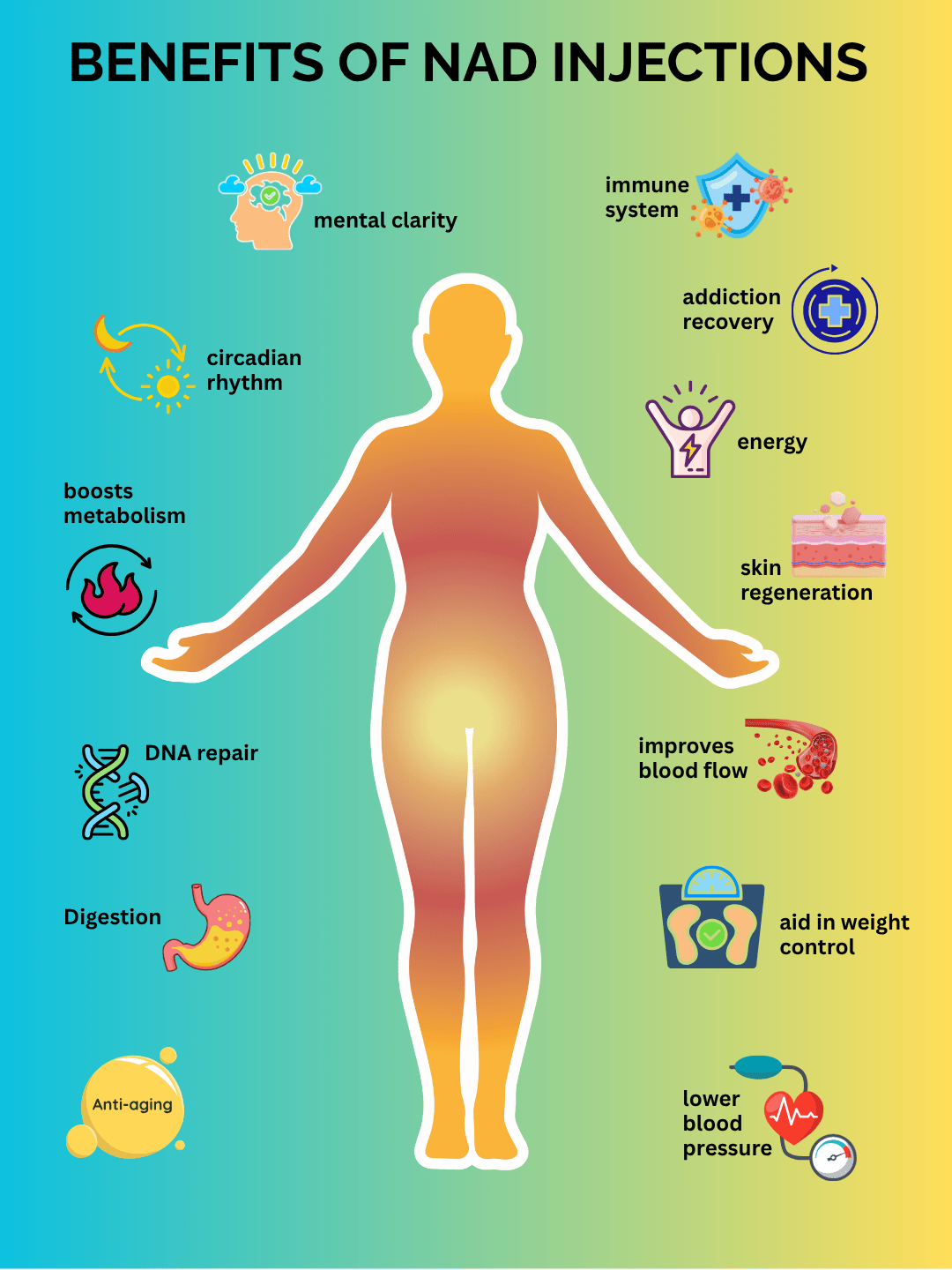
The reason NAD+ gets so much attention in longevity research isn't one single function — it's that it shows up everywhere in the biology of aging. It's a required participant in three processes that matter enormously over a lifetime:
NAD+ is essential to the electron transport chain — the process your mitochondria use to convert food into ATP, the molecule that powers everything your cells do. Without sufficient NAD+, energy production becomes less efficient at the cellular level. That inefficiency accumulates.
PARP enzymes — the proteins responsible for detecting and repairing DNA strand breaks — are entirely NAD+ dependent. Your DNA sustains thousands of damage events daily from UV exposure, oxidative stress, and normal metabolic activity. The repair system that fixes this runs on NAD+. When levels drop, repair capacity drops with it.
Sirtuins are a family of proteins sometimes called "longevity genes." They regulate inflammation, mitochondrial function, stress response, and gene expression. They require NAD+ to function. When David Sinclair and others write about NAD+ in the context of aging, sirtuins are usually at the center of that conversation.
NAD+ plays a direct role in how your body processes glucose, fatty acids, and amino acids. It supports insulin sensitivity and helps maintain metabolic flexibility — the ability to switch between fuel sources efficiently. This is part of why low NAD+ is associated with features of metabolic syndrome.
The brain is an extraordinarily energy-intensive organ — neurons rely on mitochondrial ATP production even more heavily than most cells. NAD+ supports neuronal health, axon integrity, and neurotransmitter function. Declining NAD+ levels track with the cognitive changes many people notice in their 40s and 50s.
NAD+ is a substrate for CD38, an enzyme involved in immune signaling, and for sirtuins that down-regulate inflammatory pathways. Chronic low-grade inflammation — the kind that accumulates silently with age — is partly a NAD+ story. Restoring levels supports the systems that keep that inflammation in check.
"NAD+ is one of those things where the more you understand the underlying biology, the less it sounds like a wellness trend and the more it sounds like basic cellular maintenance. The hype got there before the nuance. My job is to give you the nuance."
— Natasha Sherrill, FNP-C · New Age Medspa · Anchorage, AKHow NAD+ levels change with age
This is the part that surprised me when I first started looking at the research seriously. NAD+ decline isn't subtle — it's significant, measurable, and remarkably consistent across studies. By the time most people are in their 60s, their cellular NAD+ levels are roughly half of what they were in their 20s.
There are several reasons for the decline. NAD+ consumption increases with age as DNA repair demands go up — more cumulative damage means the PARP repair enzymes are working harder and using more NAD+. The enzyme CD38, which degrades NAD+, becomes more active with age. And the body's ability to synthesize NAD+ from dietary precursors (tryptophan and niacin) becomes less efficient over time.
NAD+ decline across the lifespan
Approximate cellular NAD+ levels relative to peak (early adulthood)
Values are approximate and reflect general trends in published research — individual levels vary based on diet, activity, stress, and genetics. The decline is real and consistent; the exact percentages depend on which tissues are measured and which studies you're referencing.
The practical consequence of this decline isn't one dramatic symptom. It's cumulative and diffuse: cells produce energy less efficiently, DNA repair becomes slower and less thorough, inflammation becomes harder to resolve, and the body's ability to adapt to physiological stress decreases. People often describe this as just feeling older — which it is, at the cellular level.
What makes NAD+ interesting is that unlike most aging-related changes, it's something you can actually do something about. You can't reverse the epigenetic changes that accumulate over decades. You can meaningfully restore NAD+ levels — and research in animals and early human studies suggests this has measurable effects on the downstream processes those levels regulate.
IV infusion vs. IM injection — what's the actual difference
If you've looked into NAD+ before landing here, you've probably seen IV infusion — the four-hour clinic visit, the high doses, the significant price tag. That's still the most common way NAD+ is delivered clinically, and it has real advantages. But it also comes with real barriers. Here's an honest side-by-side:
IV Infusion
High dose · Long sessionIM Injection
What we offerThe honest framing here: IV and IM are not competing approaches — they're different tools for different contexts. Someone who wants a significant acute intervention, is recovering from a serious illness, or wants to aggressively load NAD+ levels quickly may benefit more from IV. But IV is expensive, time-consuming, and not feasible as a regular ongoing protocol for most people.
IM injection fills a different niche. The dose is lower, the effect is more gradual, and you can do it consistently over time without it dominating your schedule or budget. For most people who want to support NAD+ levels as a long-term practice — which is really how this makes sense — IM is the more sustainable approach.
I also want to be clear about what an IM NAD+ injection is not: it's not a substitute for a structured IV loading protocol in someone with genuinely depleted levels or a serious underlying condition. If that's your situation, I'd point you toward a provider offering IV therapy. What we offer is appropriate for people who are reasonably healthy and want ongoing cellular support — not acute treatment.
Who tends to benefit most
This is where I want to set honest expectations, because not everyone experiences NAD+ injections the same way — and the people who see the most noticeable difference tend to share some common characteristics.
- Adults in their 40s and beyond who are noticing changes in energy, mental sharpness, or recovery that weren't there ten years ago. This is exactly the age range where NAD+ decline becomes clinically relevant. People often describe a slow dulling of cognitive clarity or physical resilience — this is partly a mitochondrial story, and NAD+ is central to it.
- People under high physiological or psychological stress. Chronic stress accelerates NAD+ consumption — the repair and stress-response systems that are running overtime are drawing heavily on NAD+ reserves. This includes people managing demanding jobs, caregiving, significant athletic training loads, or prolonged periods of poor sleep.
- Athletes and physically active people who want to support recovery and mitochondrial efficiency. Heavy training increases oxidative stress and PARP enzyme activity — both of which consume NAD+. Supporting NAD+ levels during periods of intense training has some evidence behind it, and many serious athletes now include it in their recovery protocols alongside other interventions.
- People who are already health-conscious and looking to support cellular function from the inside — not expecting a miracle, but wanting to be intentional about the mechanisms that drive aging. These tend to be the clients who notice the most, precisely because they're paying attention and their baseline health gives the NAD+ something to work with.
- People recovering from illness, surgery, or burnout. The physiological demand of illness or a major surgery accelerates NAD+ depletion. Supporting levels during recovery helps the cellular machinery that's working to repair and rebuild. This isn't a treatment for any specific condition — but cellular energy support during recovery is a reasonable and well-tolerated intervention.
The person who is least likely to notice a significant subjective difference: someone in their late 20s with high baseline energy, no notable stress load, sleeping well, eating well, and exercising regularly. Their NAD+ levels probably haven't declined enough for the injection to produce a perceptible change. I'd rather tell you that than take your $65.
What to expect from the injection and the protocol
NAD+ IM is administered the same way as our other wellness shots — a small injection into the deltoid (upper arm), about five minutes from check-in to done. Most people tolerate it well. A small number experience mild warmth or a flushing sensation during or shortly after the injection — this is more common with NAD+ than with B12 or D3, because NAD+ has mild vasodilatory properties at therapeutic doses. It passes quickly and isn't cause for concern.
NAD+ is not a stimulant. It doesn't produce an immediate noticeable effect the way caffeine does. What you're doing is replenishing a substrate your cells need to run their existing processes better. The results are gradual — people who respond well typically notice improved energy stability (less 3 PM crash), better cognitive clarity, improved exercise recovery, and better sleep quality over a period of weeks, not hours.
Starting protocol: We typically recommend weekly injections for the first four weeks to meaningfully build levels, then transitioning to every two weeks or monthly for ongoing maintenance. Some people stay at bi-weekly indefinitely; others find monthly is enough once levels are supported. We'll help you find your cadence based on how you respond.
Pairs well with
Other shots that complement NAD+
Vitamin & Wellness Shots · New Age Medspa · Anchorage, AK
NAD+ Injection
Pharmaceutical-grade NAD+ from a licensed compounding pharmacy. Administered by our FNP injectors. Five-minute appointment — add on to any visit or come in as a standalone. No prescription required.
Your questions
Frequently asked about NAD+ injections
A NAD+ injection is $65 at New Age Medspa in Anchorage. It's included in our Buy 4 Get 1 Free wellness shots bundle — mix and match across any of our five shots (NAD+, B12, D3, Glutathione, Lipo-Mino). No expiration date, tracked in your chart automatically. No codes, no paperwork.
IV infusion delivers a much higher dose (250–1,000 mg) directly into the bloodstream over two to four hours, typically producing stronger acute effects. IM injection delivers a lower dose (50–100 mg) into muscle tissue in about five minutes. The tradeoff is practicality — IM is fast, well-tolerated, and accessible as a regular maintenance protocol. IV is better suited to acute loading or significant depletion scenarios. They're different tools, not competing options.
We typically start with weekly injections for four weeks to build levels, then transition to every two weeks or monthly for ongoing maintenance. Some people feel well on monthly; others prefer bi-weekly for continued support. We'll help you find the right cadence based on how you respond and what you're trying to maintain.
Not usually, and that's worth understanding before you book. NAD+ is not a stimulant. You're replenishing a substrate your cells use to run existing processes — the results are gradual. People who respond well typically notice changes over weeks: better energy stability, improved cognitive clarity, better recovery from exercise or stress. Some people notice mild warmth or a flushing sensation during or shortly after the injection — this is common with NAD+ and passes quickly.
Yes. NAD+ pairs well with B12 for energy and cognitive support, and with Glutathione for antioxidant defense — reducing the oxidative stress that accelerates NAD+ consumption in the first place. Both can be administered in the same visit. You can also add any wellness shot to the end of a facial, laser treatment, or injectable appointment — no separate booking needed.
Yes. NAD+ is a molecule your body produces and uses continuously — it's not a foreign substance. IM injection at therapeutic doses has a well-established safety profile. The most common side effect is mild flushing or warmth during or shortly after the injection, which resolves on its own. We do a brief intake before your first injection to flag any relevant medications or health conditions. If you have an active cancer diagnosis or are on specific chemotherapy agents that interact with NAD+ pathways, let us know — this is one of the rare situations where we'd want to consult with your oncologist first.